
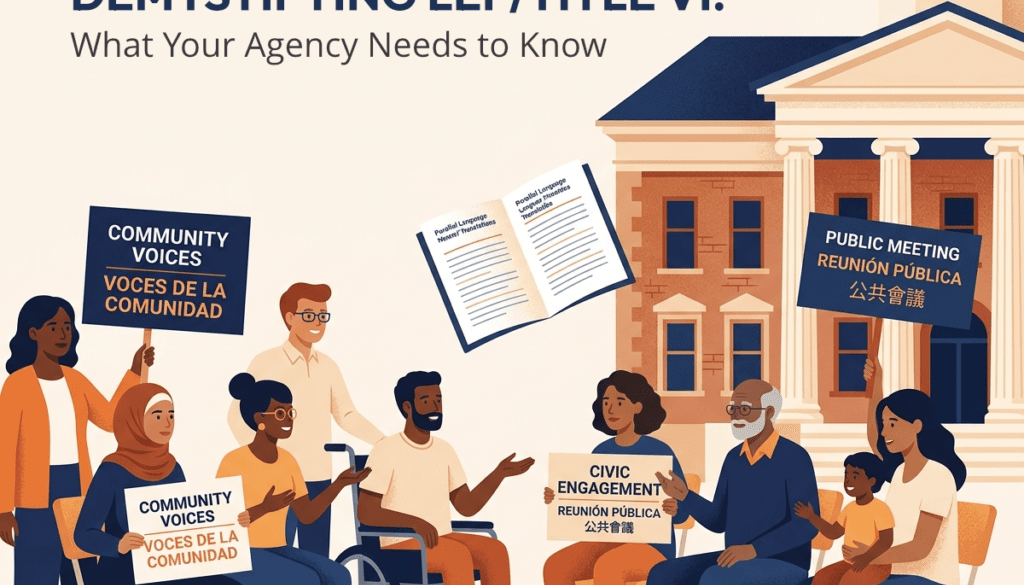
Demystifying LEP/Title VI: What Your Agency Needs to Know
If your agency receives federal funding, and most infrastructure, transportation, and municipal agencies do (Title VI of the Civil Rights Act of 1964 applies to you. So does Executive Order 13166 (Exec. Order No. 13,166, 65 Fed. Reg. 50,121 (Aug. 16, 2000).), which requires “meaningful access” for individuals with Limited English Proficiency (LEP). Noncompliance isn’t just a diversity issue; it’s a legal and financial risk.
What LEP/Title VI Actually Requires
Title VI prohibits discrimination on the basis of race, color, or national origin in any program receiving federal financial assistance. The Supreme Court has consistently held (Lau v. Nichols, 414 U.S. 563 (1974).) that this includes discrimination based on language) because language is inextricably tied to national origin. Executive Order 13166, signed in 2000, reinforced this by requiring federal agencies and their recipients to take “reasonable steps” to provide LEP individuals with meaningful access to services, programs, and activities.
For most agencies, this translates into four practical obligations:
Assessment: Conducting a four-factor analysis to determine the specific language needs of the populations you serve.
2. Language Assistance Plan: Developing a written LEP plan that outlines how you will provide interpretation and translation services.
3. Translation of Vital Documents: Translating critical materials (applications, notices, complaint forms) into the languages of eligible LEP populations.
4. Staff Training: Training frontline and public-facing staff on how to identify LEP individuals and access language services.
The 14-Language Standard
One of the most frequent questions we hear is: “How many languages do we need to support?” While there is no single federal mandate for a specific number, the practical standard that has emerged from USDOT, FHWA, and FTA guidance is the “safe harbor (U.S. Department of Transportation, Policy Guidance Concerning Recipients’ Responsibilities to Limited English Proficiency (LEP) Individuals, 70 Fed. Reg. 74,087 (Dec. 14, 2005).)” threshold. If your agency translates vital documents into languages spoken by 5% or 1,000 people (whichever is less) of the affected population, you receive a presumption of compliance.
For major metropolitan agencies, this often results in a 12-to-14-language program. At Lunar Mosaic, we support LEP/Title VI programs in 14 languages, and we design multilingual hotline and IVR systems that make language access scalable across every project phase (including Spanish, Chinese, Vietnamese, Tagalog, Korean, Arabic, and others) ensuring that your agency meets or exceeds federal safe harbor standards across every project phase.
Why Compliance Matters Beyond the Legal Requirement
Beyond avoiding Title VI complaints, fund clawbacks, and federal audits, a robust LEP program is one of the most effective tools for building community trust. When residents can engage with your agency in their preferred language, they participate more meaningfully. They show up to public meetings, respond to surveys, and provide the kind of actionable feedback that makes your projects better.
Language access is not a checkbox. It’s a strategic advantage. Agencies that invest in comprehensive LEP programs routinely report higher engagement rates, fewer public confrontations, and smoother project timelines.
Getting Started
Whether you need to build an LEP plan from scratch, audit your current compliance posture, or scale up language services for a major project, Lunar Mosaic has the expertise. Our team has designed and managed LEP/Title VI programs for transportation agencies, municipal governments, and water districts serving diverse populations across the Southwest and beyond.
Ready to ensure your agency’s Title VI compliance is bulletproof? Contact Lunar Mosaic for a consultation.